Internal-Motor Rapid Door Retrofit in a Busy Factory Passage
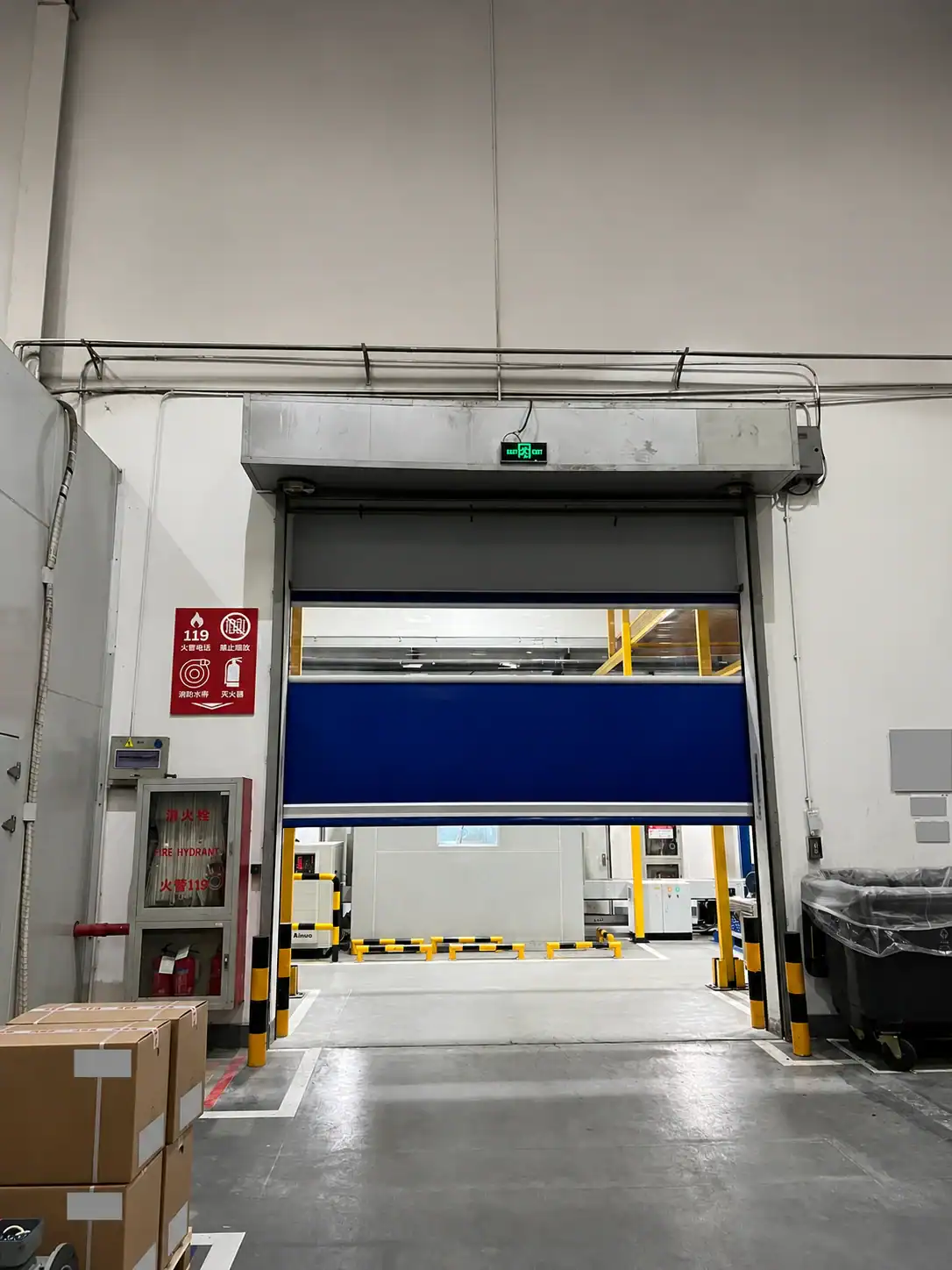
Two ageing rapid doors had become a recurring interruption to a manufacturing route. SEPPES replaced them with compact internal-motor doors, coordinated the head enclosure around existing services and installed two-sided induction-loop activation for vehicle traffic.
- Replacement package
- 2 rapid doors
- Door 1 opening
- 3,570 × 3,290 mm
- Door 2 opening
- 3,570 × 3,690 mm
- Key constraint
- Limited head and side space
Replace the doors while working around an established production route.
The retrofit treated the drive position, existing services and activation method as part of the door design rather than leaving them for separate decisions during installation.
An Existing Passage with Tight Space
The route served a manufacturing workshop and warehouse area with frequent vehicle, material and staff movement. The old rapid doors had been used for more than ten years and were experiencing recurring wear-related interruptions.
- Pipes, cable routes and building members close to the openings.
- Little space for a projecting external drive arrangement.
- A replacement programme that had to coordinate with factory operations.
The SEPPES Retrofit
SEPPES supplied two custom-sized rapid doors with internal motors and a compact head arrangement. The installation included finishing at the head and induction loops for opening requests from both approaches.
- Blue curtains with a continuous viewing band.
- Opening sizes of 3,570 × 3,290 mm and 3,570 × 3,690 mm.
- Removal, installation, loop installation and functional handover.
Use the actual installation envelope to compare layouts.
| Design item | Project arrangement | Review for another retrofit |
|---|---|---|
| Door dimensions | Two 3,570 mm-wide openings, with clear heights of 3,290 mm and 3,690 mm. | Measure each opening separately and confirm the usable clearance after the new assembly is fitted. |
| Drive layout | Internal motor arrangement within a compact head assembly. | Compare headroom, side projections and service access on the complete drawing. |
| Head interface | Custom rear cover and local finishing at the opening. | Identify gaps, nearby services and responsibility for the completed frame-to-building junction. |
| Curtain and visibility | Blue flexible curtains with continuous transparent viewing sections. | Match viewing position to the actual approach directions and carried loads. |
| Vehicle activation | Induction loops on both sides of the route. | Provide approach paths and surface details; agree loop positions and the treatment of adjacent traffic. |
Compact equipment still needs usable access for maintenance.
The two central design decisions were the drive envelope and the request position. Both were shaped by the existing route rather than by the nominal door width alone.
Resolve the Head and Side Clearances
The project used the internal-motor arrangement to work within the available space around the opening. The head cover and overall dimensions were coordinated with existing columns, pipework and cable routes.
For another passage, record the entire elevation and the access needed to remove covers or reach service points. A compact exterior does not remove the need for inspection and maintenance space.
Position the Vehicle Request Deliberately
Induction loops were provided at both approaches so vehicle movement could request opening. Their location had to fit the actual traffic route and the floor work needed for installation.
Agree where a loaded vehicle waits, which adjacent movements should not request the door and how staff use the same passage. An opening request and the door’s protective functions are separate parts of the operating arrangement.
Coordinate removal, new fitment and floor work.
Confirm the Existing Conditions
The team reviewed both openings, nearby services, clearance constraints and the required vehicle approaches.
Manufacture the Custom Package
The two door sizes, compact internal-drive arrangement and head-cover details were prepared for the existing passage.
Replace and Finish
The old assemblies were removed, the new doors fitted and the head interfaces finished. Floor work provided the induction-loop routes.
Check the Operating Functions
Door travel and activation from both approaches were checked before the replacement package was handed over to the factory.
Two renewed door assemblies within the existing layout.
The case describes the replacement configuration and completed checks. It does not establish a measured throughput increase or a guarantee against every type of collision or interruption.
A Fit for Restricted Space
The completed package used internal drives and customised head details around the existing structural and service constraints. The two openings retained individually defined dimensions.
Vehicle Requests from Both Approaches
The agreed loop arrangement connected the new doors to the traffic using the passage. The handover included operating checks rather than treating the sensor installation as a separate task.
Make the removal and operating brief part of the enquiry.
| Survey item | Information to send | Question to settle |
|---|---|---|
| Existing door and opening | Inside and outside photographs, clear dimensions and removal constraints. | What can be retained and what finishing or support work is needed? |
| Space around the door | Headroom, side clearances, pipes, cable routes and maintenance access. | Which drive arrangement fits the complete installation envelope? |
| Traffic and activation | Vehicle types, loaded dimensions, routes, waiting points and pedestrian use. | Where should requests originate and how will shared use be managed? |
| Work and handover | Factory access windows, floor work, power, operating checks and document needs. | Who coordinates the replacement and accepts the operating route? |
Compare the complete retrofit package.
Is an internal motor always the smallest installation?
Review the actual offered drawing. The complete head, guides, cover-removal space and service access determine whether the assembly fits the available location.
Can both replacement doors use one set of dimensions?
Measure each opening and its finished interfaces separately. This project used the same clear width but two different clear heights.
Do induction loops provide every required protective function?
No. They provide an opening request from the agreed vehicle route. Review the protective devices, other users and exceptional operating conditions as separate parts of the design.
What helps reduce surprises during removal?
Record the existing fixings, concealed-service concerns, floor condition, access and production windows. Agree who handles repairs, finishing and the final operating checks before work begins.
Replacing rapid doors without changing the surrounding factory layout?
Share the opening photographs, dimensions, operating duty and site constraints. SEPPES can help review the equipment configuration, supporting interfaces and scope of supply and installation.